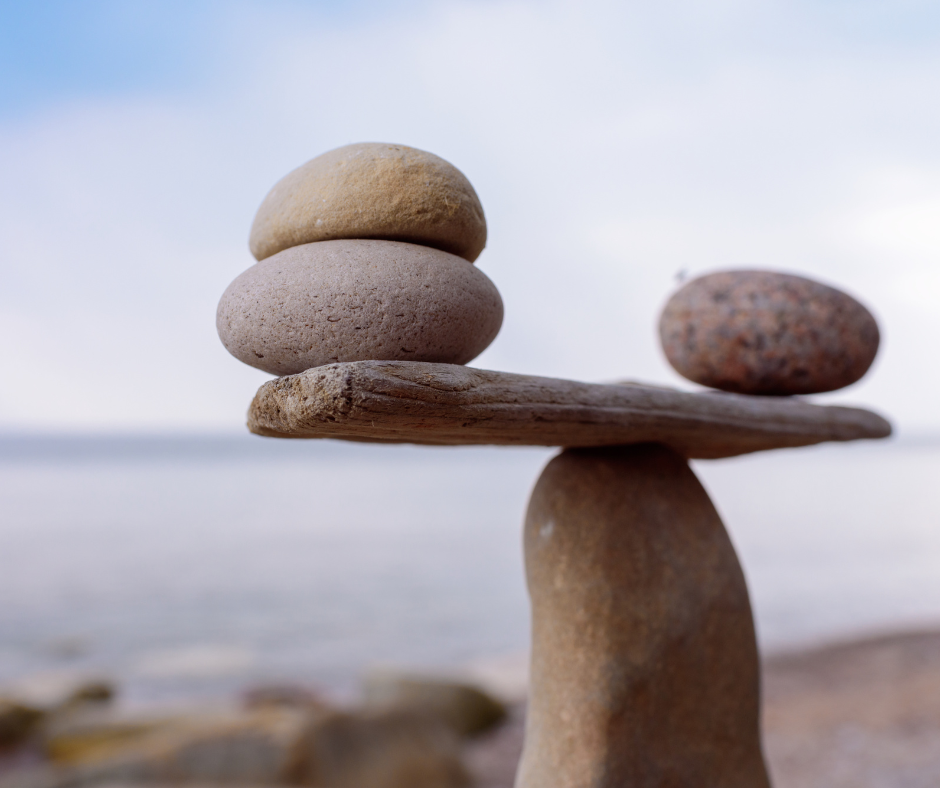
Find your balance
Balance is a wide topic and I’d like to discuss it on three levels.
- Balance in its most basic meaning of an even distribution of weight allowing us to remain upright
- Body balance in the context of tensions, strength, motion ranges, positon
- Balance understood as the harmony and hygiene of life
Re: 1
The ability to keep balance. Sounds like something obvious, but it’s good to understand that a lot depends on it, and not only in the context of sport and dance, but also our health.
In the case of the elderly, maintaining balance is one of the most fundamental issues, since falling over at an older age usually puts us at the risk of becoming immobilised for a longer time, and then it’s usually very hard to get back in shape to the state from before the injury.
There are, of course, younger individuals whose balance is negatively affected whether due to a balance disorder, or a proprioceptive dysfunction (they can’t sense their body in space), or weak eyesight and issues interpreting signals received by their brains. These problems may significantly reduce the quality of life and may cause many issues.
In the rare instance of damage to the sense of balance, one may not be able to move normally because of conflicting messages from one’s body. For example, one may feel as if the room is spinning or the floor is tilting and so on. A cause for optimism in such situations is our brain’s neuroplasticity, thanks to which even serious damage may be otherwise compensated – the brain can learn how to use other senses in certain situations, it just needs to be shown the path how (I’d like to recommend Norman Doidge’s book The Brain that Changes Itself here).
When it comes to dancing and physical activity (assuming we’re healthy), a good sense of balance will help us achieve a much higher quality and steadiness in our way of moving. When we’re off balance, our body reacts instinctively and tenses up in order to prevent us from falling over, however, unfortunately, this is more of a disservice, since we end up losing balance even more.
As to not fight our own body and be able to execute natural, harmonious and relaxed movements, we need to feel and control our sense of balance very well, and this is the understanding of balance I endorse in the context of physical activity and dance. It needs to facilitate as natural and delicate use of our body as possible, as well as help us to totally relax. With this control, we won’t have any problems exerting a lot of force in movement when we need it.


Re: 2
A balanced body means that the forces in our body travel harmoniously, and neither side of the body or a single muscle is exceedingly stronger than the other or the rest.
Let’s take our spine as an example and imagine it as an anchored tent. If one of the guy ropes is too tense or too limp in comparison to others, the ridge pole won’t be stable. The same is with our spine: it’s kept upright thanks to musculofascial tension, but if one side of this structure is pulling too strongly or too lightly, after some time, it may affect the health of our spine, since everyday tensions won’t be released as they should. This pertains spine stretch and bend, rotations in both sides, motion ranges, strength, endurance etc.
Of course, there will always be some sort of imbalance in our body. We’re not perfectly symmetrical after all, which can be clearly seen for example in the layout of our internal organs. Almost all of us have a dominant side, so if you’re right-handed, it’s highly probable that your right hand will be slightly stronger. Nonetheless, we should aim to reduce the imbalance if it’s too radical. A well-balanced body will serve us better than a one with one side too overburdened, because a part of it is too weak or too strong.
Re: 3
Finding a balance in one’s life in the modern times is extremely important, but also extremely difficult.
We’re overstimulated, chronically stressed, overworked, we sleep to little, not regenerate properly, eat processed foods, live in a polluted environment, and on top of it all, we spend too much of our time in sitting down (a sedentary lifestyle is becoming the disease of the 21st century – in some time, there will be more about it in another article).
The body and the mind are strongly connected and influence each other a lot more frequently than we think. An unfit and exhausted body leads to many illnesses, also neurological and psychological, and a prolonged bad mood or depression is a fast track to bad posture, weakened organism and lowered immunity.
Looking at this from another angle, a good/positive attitude can improve our mood and even smile alone, even if it’s a little bit forced, induces a positive reaction of the body. It means that positive thinking can positively influence the quality of our movement and our physical well-being.
We have only one body, and every system in it affects others. Yet despite the growing awareness on the topic, a lot of people still don’t realise how important it is to take care of one’s body and mind, or the awareness is not high enough to at least make everyone start sufficiently taking care of themselves. How come we take care of our cars so they can serve us without any breakdowns for many years, but we can’t do the same for our own body? That body which works for us every day, but which we can’t replace with a new model?
To be fair, more or less every 7 years almost all of our cells are replaced with new ones, and in the meantime our body adapts to our most frequent activities. So even if we’re not happy with the way our body functions in the given moment, we just need to be consistent, exercise sensibly and rely on the long period of adaptation, and in a few years it might just happen that we replace ourselves with a significantly fitter and healthier version.
It’s extremely important to commune with nature, choose a book over a film, opt for physical activity and, per personal preference, practice meditation / mindfulness / breathing / praying instead of spending your free time in front of a computer. Furthermore, go for human contact – but the real kind, not online – as well as an unprocessed foods diet, positive thinking and a smile.
In my opinion, these three points are the most important aspects we should begin with when considering physical activity, dance and health. I wish for all of you to find your balance, even if it sometimes seems difficult!